


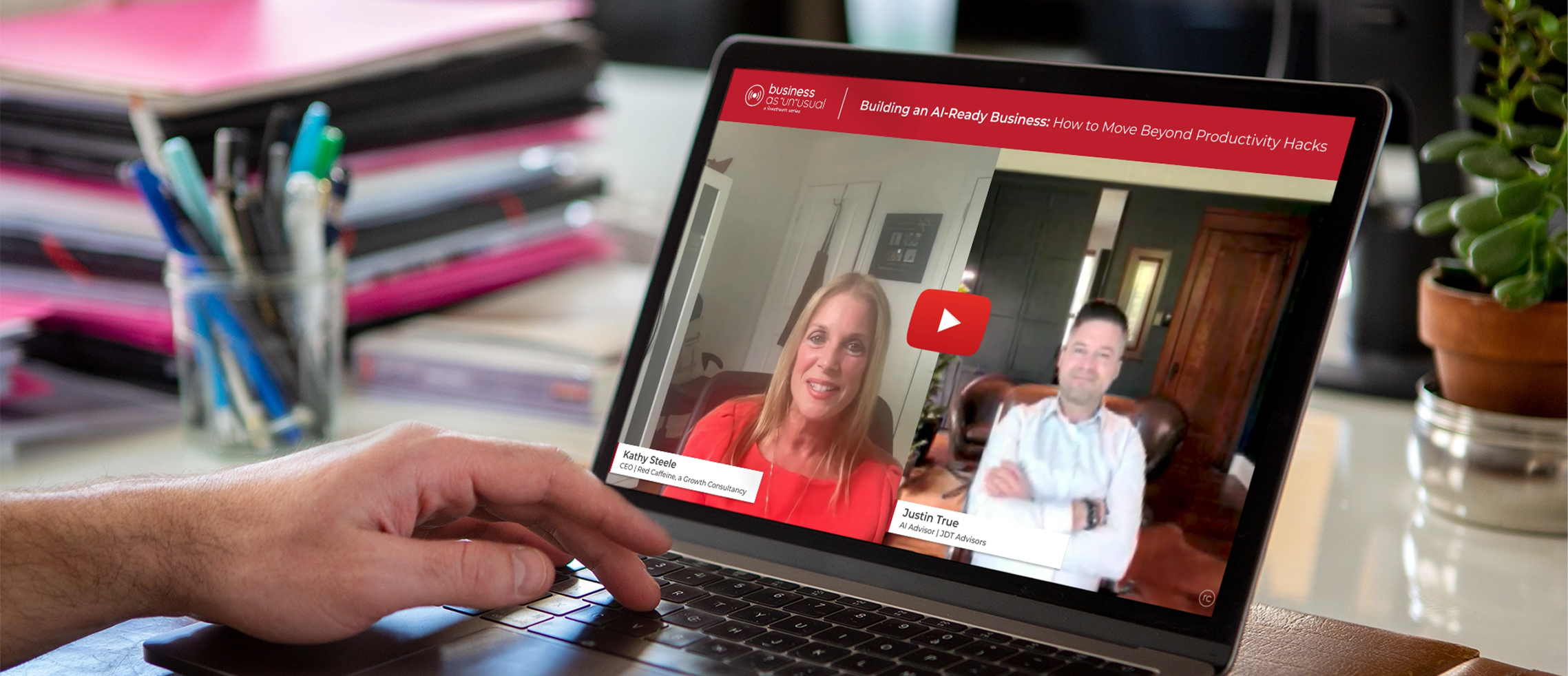
AI is already inside most businesses. The question is whether it is being used intentionally.
That was the focus of Red Caffeine’s recent Business as “Un”usual session, Building an AI-Ready Business: How to Move Beyond Productivity Hacks, featuring Red Caffeine CEO Kathy Steele and Justin True, Founder and AI Advisor at JDT Advisors.
The conversation also reflects the work Red Caffeine and JDT Advisors are doing together to help mid-market companies move from AI experimentation to practical AI adoption. Red Caffeine brings the growth strategy, go-to-market, and workflow architecture lens. JDT brings the training, facilitation, and organizational enablement expertise needed to help teams build confidence and change behavior. Together, the partnership helps leadership teams identify where AI can create value, redesign the workflows around those opportunities, and train people to use AI in ways that are practical, responsible, and repeatable.
For many mid-market companies, AI adoption has started at the individual level. Someone uses ChatGPT to write faster. Someone else uses it to summarize notes, brainstorm ideas, or speed up a task that once took an hour. That kind of experimentation has value, but it is not the same as building an AI-ready business.
The bigger opportunity is not to give every employee a chatbot and hope for the best. It is understanding where AI can remove friction from the way the business actually runs.

The Gap Is Widening
AI tools are evolving quickly, and companies are not keeping pace. Justin described this as the “AI acceleration gap”—the distance between where an organization is today and what the technology can already support.
For leaders, that gap can feel overwhelming. It is easy to imagine a complex future-state workflow before the business has built the foundation to support it. But AI readiness does not start with a fully automated system. It starts with one practical use case, one trained team, one process improved, and one lesson carried into the next project.
The companies that wait for everything to feel clear may find that the work gets harder later. The tools will keep advancing. The cost, complexity, and competitive pressure will likely continue to rise. Getting started now gives companies time to learn while the stakes are still manageable.
Readiness Starts with Leadership
AI readiness is not primarily a technology decision. It is a leadership decision.
Before choosing platforms or building workflows, leaders need to agree on what they are trying to accomplish. Where should AI show up in the business? What risks need to be managed? Which teams need support first? What would make the investment worthwhile?
From there, companies need a clear view of how employees are using AI today. Some team members may already be experimenting heavily. Others may not know where to begin. That mix matters because AI adoption will not scale evenly without training, policy, and shared expectations.
The goal is not to turn everyone into a prompt expert. The goal is to help each person understand how AI can support the work they are already responsible for. Once that happens, teams start seeing use cases everywhere: repetitive questions, manual data entry, disconnected systems, reporting delays, handoffs, reviews, and bottlenecks.
Shadow AI is Already a Business Risk
One of the most urgent issues for leaders is shadow AI.
Shadow AI happens when employees use AI tools without clear company guidance, security standards, or oversight. Sometimes this happens because no official tool exists. Other times, the company has chosen a tool, but employees work around it because it does not meet their needs.
Both situations create risk. Employees may be putting sensitive company, customer, financial, or employee information into tools the business does not control. But simply telling people not to use AI will not solve the problem, especially when AI features are already embedded in everyday business platforms.
A better approach is to give teams secure, capable tools that are practical enough to use. Governance only works when it is paired with usefulness.

The Bigger Gains Are Operational
Personal productivity has a ceiling. A person can only copy and paste so many tasks into a chatbot before the process itself becomes the constraint.
Operational AI looks different. It embeds AI into a workflow.
Justin shared the example of invoice processing. Instead of asking someone to open invoices, read line items, reformat data, and enter it into a spreadsheet, an AI-enabled workflow could monitor a folder, read the document, structure the information, and move it into the right place for review.
That same logic applies across finance, HR, sales, marketing, operations, customer service, and delivery. Anywhere people are moving information from one format to another, answering the same questions repeatedly, or preparing data for decisions, there may be an opportunity to improve the process.
This is where training and workflow architecture need to work together. Training helps people understand what AI can do and how to use it with more confidence. Workflow architecture helps the business decide where AI belongs, how the process should change, and what needs to be in place to make the improvement repeatable. Without both, AI often remains stuck at the level of individual productivity rather than becoming an operating capability.
The point is not to remove people from the business. It is to give people more room to do the thinking, judgment, relationship-building, and problem-solving that actually create value.
AI Readiness Is Becoming Part of Enterprise Value
For mid-market organizations, AI is quickly becoming more than an efficiency tool. It is becoming part of how companies scale, compete, and prepare for what comes next.
A business that uses AI to reduce bottlenecks, improve service levels, strengthen data visibility, and increase team capacity will operate differently from one that waits. Over time, that difference can show up in growth, margin, customer experience, and acquisition readiness.
The right starting point is not a massive transformation project. It is an honest look at where your business is today: how work moves, where friction lives, what your team needs to learn, and which workflows are ready for a better approach.
Start with the work. Build from there. That is how AI moves from a personal productivity tool to a business growth strategy.
Want to hear the full conversation? Watch the Business as “Un”usual session on-demand.
Ready to move beyond AI experimentation? Schedule a discovery call with Red Caffeine and JDT Advisors to identify practical AI opportunities, workflow priorities, and training needs for your team.

If You Enjoyed This Article, Read These Next.


Join Thousands Of
Like-Minded Folks
Receive monthly business growth tips
and event invites right to your inbox.


